
Insights
Writing a Dissertation Chapter

- Chapter 1 Introduction (broad overview of the research)
- Chapter 2 Review of the literature (and conceptual framework)
- Chapter 3 Methodology
- Chapter 4 Results or Findings
- Chapter 5 Interpretations, Conclusions, and Recommendations
- References
- Appendices
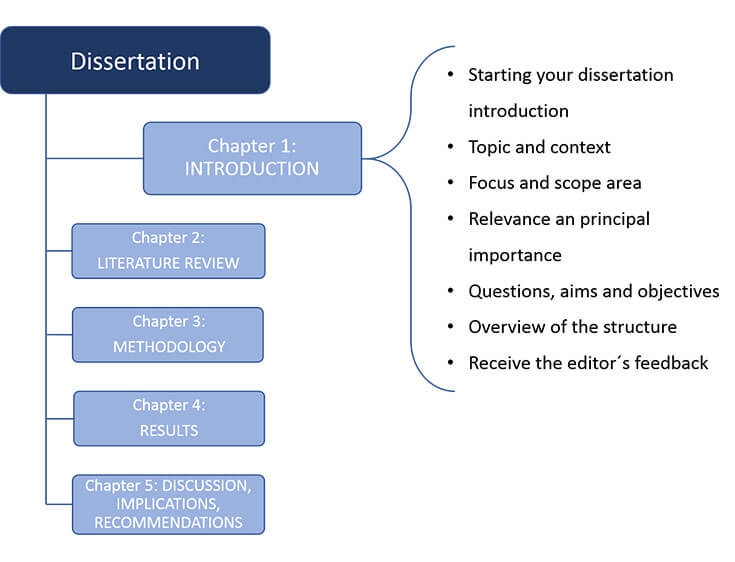
CHAPTER 1: INTRODUCTION
Provides an overview of the research topic, its background, the specific problem being addressed, research aims, and significance.
This chapter introduces and provides an overview of the research to be undertaken. Chapter 1 normally should be written after Chapters 2 and 3... Dissertation chairs often want a 5-10 page overview (“prospectus”) before full literature review and methodology. The final draft of Chapter 1 should summarize Chapters 2 and 3. Preliminary literature exploration ensures the problem and research questions are meaningful. Over-researched topics, contradictory results, or under-researched areas guide refinement. 1-A. Overview: Explain why the study is undertaken and the main questions/problems addressed. 1-B. Statement of the Problem: Describe gaps, inadequacies, or perplexities in theory, practice, policy, or empirical knowledge prompting the study. Include causes and consequences. 1-C. Purpose: Explain how the research acquires knowledge to address the problem. Quantitative: answer questions/test hypotheses. Qualitative: explore foreshadowed problems/conjectures. Mixed-methods: both approaches. 1-D.1. Research Questions or Hypotheses: Define specific research questions or testable hypotheses. Qualitative studies may present tentative hunches. 1-D.2. Significance: Explain potential contributions to theory, knowledge, practice, policy, and future research. 1-E. Conceptual Framework: Summarize theoretical foundation from literature review, variables, and predicted relationships. 1-F. Summary of Methodology: Briefly summarize methodology, detailed in Chapter 3. 1-G. Limitations: Outline internal validity, generalizability, and applicability limitations, including delimitations, ethical constraints, or methodological shortcomings. Quantitative Research: Present research questions/hypotheses as in Chapter 3. Qualitative Research: Present foreshadowed problems, conjectures, or exploratory questions as in Chapter 3. 1-H. Definition of Terms: Define key research terms and cite sources. Sections 1-E, 1-G, and 1-H may appear elsewhere in the dissertation.
CHAPTER 2 REVIEW OF THE LITERATURE
This chapter surveys and analyzes existing scholarly work related to the research topic to provide a conceptual framework.
Scholarly research moves from the known to the unknown. The literature review and conceptual framework build the platform of the known... The literature review informs: a) The problem and its significance b) The theoretical foundation/conceptual framework c) Research questions, hypotheses, foreshadowed problems, or conjectures d) Research paradigm and methodology 2-A. Introduction: Describe the topic, purpose, and methods of the literature review. Include indices, search terms, and years searched. Be selective if literature is voluminous. 2-B. Description and Critique: Summarize and critique major theoretical, conceptual, and empirical studies. Highlight strengths and weaknesses. Focus on primary sources. Organize by topics, theories, constructs, or methodologies. Avoid bias—critique literature consistently regardless of your predispositions. 2-C. Inferences for Forthcoming Study: Synthesize literature to draw inferences for your research problem, questions/hypotheses, framework, and methodology. Consider problem extent, causes, consequences, prior frameworks, and best/worst research paradigms. 2-D. Theoretical/Conceptual Framework: The framework provides a lens for the research problem, guiding decisions without dictating them. It helps narrow focus but may restrict breadth. Sometimes breakthroughs occur by using a novel framework.
CHAPTER 3: RESEARCH DESIGN AND METHODOLOGY
This is an essential chapter and it details the research design and methods used to conduct the study.
The methods are the procedures used to acquire empirical evidence and analyze it for purposes of answering research questions, testing hypotheses, and examining foreshadowed problems... The choice of methodology should follow the literature review and careful deliberation. Small oversights can undermine the study. Your committee will guide refinements. Approved proposals act as a blueprint: in experimental research, changes are rarely made; in other quantitative and qualitative studies, some adjustments may be appropriate with committee consultation and IRB approval for human subjects. Some method details are unknown until data collection, such as response rates or whether data meet statistical assumptions. Consequently, Chapter 3 may need updates from the proposal. 3-A. Methodology: Reintroduce the problem and summarize the methodological approach. 3-B. Conjectures/Exploratory Questions: State the conjectures or exploratory questions guiding the study. Qualitative research cross-verifies among multiple data sources and infers patterns during ongoing analysis. 3-C. Research Procedures: Describe procedures in sufficient detail for replication. a) Introduce the guiding epistemology. b) Explain the theoretical perspective and rationale. c) Specify the methodology and justification. d) Detail methods: site, case, and informant selection, data collection, verification, and bias control. Append guides/protocols used. e) Describe qualitative data management: note-taking, recordings, and unanalyzed data. f) Explain data analysis and interpretation, ensuring alignment with methodology. Detail coding, reliability checks, triangulation, and interpretation processes. 3-D. Human Participants and Ethics: Summarize potential risks, informed consent procedures, and risk minimization. Include other ethical considerations such as conflicts of interest or biases. Data collection begins only after IRB approval.
CHAPTER 4: RESULTS/FINDINGS
This chapter presents the data collected and the outcomes of the research analysis.
Data analysis, whether quantitative or qualitative, is intended to summarize a mass of information to answer research questions, test hypotheses, examine foreshadowed problems, and explore conjectures... Results are generally reported in Chapter 4 and interpreted in Chapter 5. For some qualitative methods, analysis and interpretation may be intertwined, but Chapter 4 interpretation should remain low-level, with higher-level insights reserved for Chapter 5. The text should tell a coherent story and highlight important results, presenting less-important findings more briefly. Key considerations include: (a) Epistemology, theoretical foundation, or conceptual framework; (b) Main questions, hypotheses, or conjectures; (c) Magnitude and statistical significance or cross-validation of results; (d) Consistency across measures and constructs; (e) Implications for theory, knowledge, practice, policy, and future research. Avoid overwhelming readers with raw statistics; highlight important results in tables, graphs, charts, or examples. Less important findings may go in the text briefly, in tables, or in an appendix. Standardize terminology throughout the dissertation to avoid confusion. 4-B. Text: Focus on key results, devoting less attention to minor outcomes. Note patterns and inconsistencies, and briefly report response and item-completion rates. 4-C. Reporting Statistics: Include standard deviations with means, report “n”s, p-values, and effect sizes (e.g., omega squared, r squared). Discuss non-significant results and potential low statistical power. 4-D. Tables, Graphs, and Charts: Use tables for condensed results, bold key findings, and keep graphs simple and well-presented. Introduce each table/chart in the text and follow with discussion if needed. 4-E. Raw Data: Individual participant data is usually not reported unless the sample is small. Include illustrative quotes carefully without violating informed consent. Full data may be placed in an appendix. Raw data should be kept for at least five years per APA guidelines and made available for reanalysis if requested.
CHAPTER 5: CONCLUSIONS, INTERPRETATIONS AND RECOMMENDATIONS
The aim of this chapter is to allows the researcher to interprets the results, discusses their implications, and summarizes the study's contribution to the field
This is the chapter in which you give meaning to the results partly by tying them to past theory, research, policy, and practice and partly by extrapolating them to future theory, research, policy, and practice... Chapter 5 is a time for imagination and boldness, but with scholarly caution. Interpretations, conclusions, and recommendations must have a basis in your study and are more credible if supported by prior literature. Students often rush Chapter 5 after finishing Chapters 2–4, but it requires a broader perspective. Take a break after Chapter 4 and review your notes, literature review, and Chapter 4 points. 5-A. Summary: Briefly summarize the problem and main results, indicating whether hypotheses were supported. 5-B. Conclusions: Interpret results considering the literature, theoretical/conceptual framework, and limitations. Ask what results mean and don’t mean, their causes, and consequences. Distinguish between what is learned with certainty, tentatively suggested, or not learned. Use cautious generalizations and informed speculation, clearly signaling when speculating. Interpretation of significant large results is usually straightforward; small significant results require care—significance does not equal importance. Non-significant results may hide real effects due to low power. Apply these principles to qualitative research as well. 5-C. Recommendations: Suggest actions based on results and literature, considering limitations. Implications may affect theory, practice, policy, and future research. Anticipate implementation challenges and unintended consequences. Recommendations can be tentative, advisory, or exhortative (avoid the latter in dissertations).