
Insights
Strategies for Writing a Great Essay

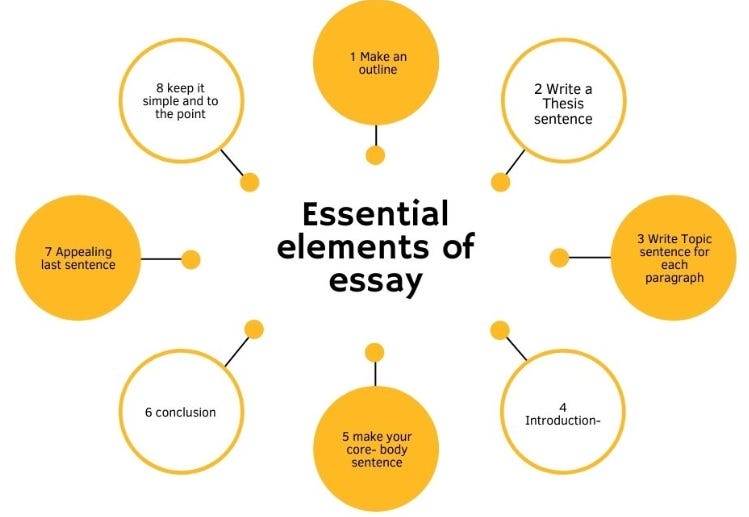
An essay is a piece of writing that is written to convince someone of something or to simply inform the reader about a particular topic. In order for the reader to be convinced or adequately informed, the essay must include several important components to make it flow in a logical way.
The main parts (or sections) to an essay are the intro, body, and conclusion. In a standard short essay, five paragraphs can provide the reader with enough information in a short amount of space.
For a research paper or dissertation, however, it is essential that more than five paragraphs are present in order not to overwhelm the reader with too much information in one paragraph.
Guide to Different Kinds of Essays
An essay is a paper that discusses, describes or analyzes one topic. It can discuss a subject directly or indirectly, seriously or humorously. It can describe personal opinions, or just report information. An essay can be written from any perspective, but essays are most commonly written in the first person (I), or third person (subjects that can be substituted with the he, she, it, or they pronouns).
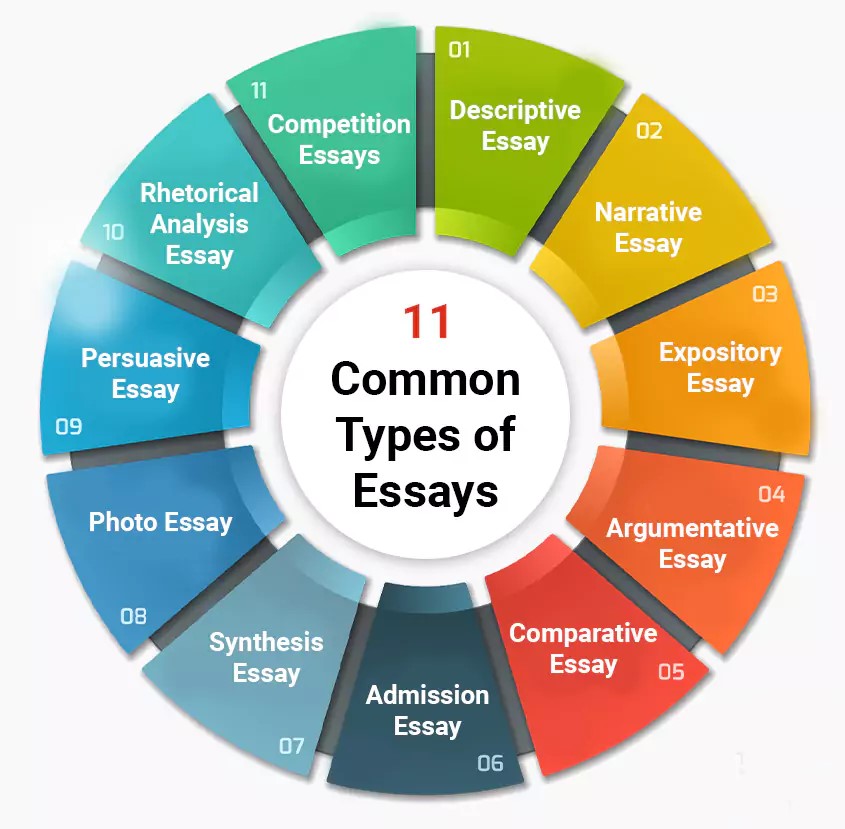
Essays are not just short stories describing action or process (Like the beloved “How I spent this summer” essay). The work is much more complex. People use essays as a way to analyze, discuss some topics, persuade readers or prove ideas. So each custom essay should be specific and unique depending on purpose and type.
Different essays are designed to do different things. Some essays are designed to find out what you’ve learned about a particular aspect of your course. Some are designed to find out what you’ve learned at a particular stage of your course. Others are designed to see how well you understand and can apply key concepts in your subject.
Different varieties of essay will require different types of writing. Each type has its rules and unique features. Understanding the structure, style, or anything else in a particular kind, and how it differs from another will help to write better essays and spend less time on doing the preparation and work itself.
Tips for Writing a Great Essay
When you receive a paper assignment, your first step should be to read the assignment prompt carefully to make sure you understand what you are being asked to do. Sometimes your assignment will be open-ended (“write a paper about anything in the course that interests you”). But more often, the instructor will be asking you to do something specific that allows you to make sense of what you’ve been learning in the course. You may be asked to put new ideas in context, to analyze course texts, or to do research on something related to the course.
1. Analyse the question
Student essays are responses to specific questions. As an essay must address the question directly, your first step should be to analyse the question. Make sure you know exactly what is being asked of you.
Generally, essay questions contain three component parts:
- Content terms: Key concepts that are specific to the task
- Limiting terms: The scope that the topic focuses on
- Directive terms: What you need to do in relation to the content, e.g. discuss, analyse, define, compare, evaluate.
Look at the following essay question:
Discuss the importance of light in Gothic architecture.
- Content terms: Gothic architecture
- Limiting terms: the importance of light.
- Directive term: discuss.
2. Define your argument
As you plan and prepare to write the essay, you must consider what your argument is going to be. This means taking an informed position or point of view on the topic presented in the question, then defining and presenting a specific argument.
Consider these two argument statements:
The architectural use of light in Gothic cathedrals physically embodied the significance of light in medieval theology.
Or:
In the Gothic cathedral of Cologne, light served to accentuate the authority and ritual centrality of the priest.
Statements like these define an essay’s argument. They give coherence by providing an overarching theme and position towards which the entire essay is directed.
3. Use evidence, reasoning and scholarship
To convince your audience of your argument, you must use evidence and reasoning, which involves referring to and evaluating relevant scholarship.
- Evidence provides concrete information to support your claim. It typically consists of specific examples, facts, quotations, statistics and illustrations.
- Reasoning connects the evidence to your argument. Rather than citing evidence like a shopping list, you need to evaluate the evidence and show how it supports your argument.
- Scholarship is used to show how your argument relates to what has been written on the topic (citing specific works). Scholarship can be used as part of your evidence and reasoning to support your argument.
Remember – your teacher is marking dozens of essays so if you keep your work interesting they’ll love you for it.
4. Organise a coherent essay
An essay has three basic components - introduction, body and conclusion.
Introduction:
Grab attention and move from general to specific, ending with a clear thesis statement.
Provide a “road map” of the essay, showing what will be discussed.
Body:
Support your thesis with evidence, examples, and topic sentences.
Organize ideas logically (chronological, spatial, or emphatic) and use transitions.
Conclusion:
Summarize main arguments and restate the thesis simply.
Leave the reader with a final thought or something to consider.
5. Write clearly & Concise
An essay that makes good, evidence-supported points will only receive a high grade if it is written clearly. Clarity is produced through careful revision and editing, which can turn a good essay into an excellent one.
When you edit your essay, try to view it with fresh eyes – almost as if someone else had written it.
Ask yourself the following questions:
Overall structure
- Have you clearly stated your argument in your introduction?
- Does the actual structure correspond to the ‘road map’ set out in your introduction?
- Have you clearly indicated how your main points support your argument?
- Have you clearly signposted the transitions between each of your main points for your reader?
6. Cite sources and evidence
Finally, check your citations to make sure that they are accurate and complete. Some faculties require you to use a specific citation style (e.g. APA) while others may allow you to choose a preferred one. Whatever style you use, you must follow its guidelines correctly and consistently. You can use Recite, the University of Melbourne style guide, to check your citations.
Further resources
- Germov, J. (2011). Get great marks for your essays, reports and presentations (3rd ed.). NSW: Allen and Unwin.
- Using English for Academic Purposes: A guide for students in Higher Education [online]. Retrieved January 2020 from http://www.uefap.com
- Williams, J.M. & Colomb, G. G. (2010) Style: Lessons in clarity and grace. 10th ed. New York: Longman.